Circus Animal Training Rules
The One and Only IvanCircus Animal Training Rules are presented not as a written code but as repeated practices that turn animal movement into a performance: ropes and chains restrict the body, treats reward obedience, and the claw-stick threatens pain. Through Stella’s history and Ruby’s arrival at the mall, the novel connects spectacular tricks to the coercion behind them. The contrast with Ruby’s later, patient training to enter a transport box makes clear that instruction need not depend on force.
Training for Performance
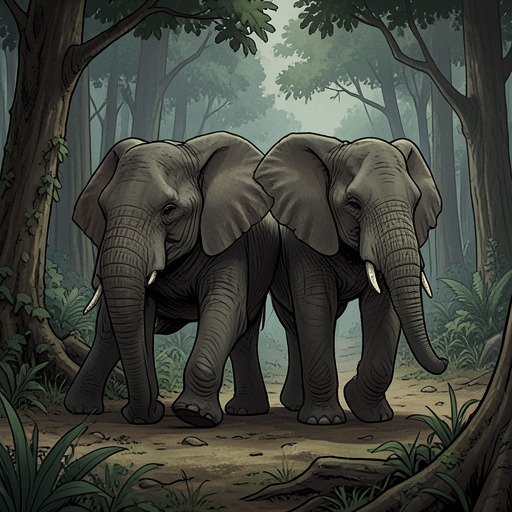
Stella’s experience establishes how the circus makes difficult tricks part of an animal’s working life. She had performed in a large, famous circus and still performs some of those tricks in the mall show. In one stunt she stands on her hind legs while Snickers jumps onto her head, a feat made especially demanding by her great weight. The performance has a simple rule: an elephant who complies receives a treat; one who does not faces the swinging claw-stick. The apparent neatness of that exchange conceals its coercion. The trick is presented to spectators as entertainment, but the animal’s choice is governed by the expectation of pain.
The claw-stick is dangerous precisely because the body it is used against is not invulnerable. Stella’s hide is thick, yet its sharp hook can pierce it. She recalls seeing a trainer strike a bull elephant with one. When the hook caught in the bull’s flesh, he tossed the trainer into the air with his tusk; Stella never saw the bull again. The episode reveals both the weapon’s capacity to injure and the volatility created when force meets resistance. It also complicates the show’s performance logic: the animal is expected to submit, but the threatened body remains powerful.
Stella’s Injuries and the Cost of Training
Stella’s body carries a longer record of training and confinement. As a young elephant she wore chains, whose scars she calls her bracelets. At the famous circus, she had to balance on a pedestal for her most difficult trick. She fell and injured her foot; when she became lame and lagged behind the other elephants, the circus sold her to Mack. Her transfer followed a decline in her usefulness to the performance, rather than recovery from the injury.
The foot never healed completely. Stella limps, and standing in one place for too long can make it infected. The previous winter it swelled to twice its normal size; feverish, she lay on the cold, damp floor of her domain for five days. These details show that the consequences of training outlast the act itself. The circus trick is a brief spectacle, but the injury remains part of Stella’s daily life, while the scars of earlier chains stay visible on her legs.
Ruby’s Conditioning
Ruby arrives at Exit 8 Big Top Mall after being bought by Mack from another circus. Stella explains that Ruby had been in a truck for days, was too thin, and had been born in the wild. Before reaching the mall, Ruby had been chained to the floor by all four feet for twenty-three hours a day. Stella says the trainers did this to break her spirit so she could learn to balance on a pedestal, stand on her hind legs, and walk in circles while a dog jumped on her back. The account makes the intended sequence explicit: restraint is used to overcome resistance, and the resulting compliance enables a set of tricks.
At the mall, Mack begins training Ruby soon after Stella’s death. Her feet are looped with rope so she cannot run, and a heavy chain hangs from her neck. Mack brings out Stella’s ball, pedestal, and stool, then introduces Ruby to Snickers. Obedience earns a cube of sugar or a piece of dried apple; failure brings yelling and kicks at the sawdust. The familiar props link Ruby’s lessons to the performance Stella had carried out before her. The reward does not remove the restraint around Ruby’s feet or the chain at her neck; it works within a training session already structured to limit her movement.
The session escalates when Ruby will not move as Mack wants. After he pulls on her chain and falls to his knees, he goes to his office and returns with a claw-stick. Its hook first touches Ruby, and Mack says he wants to get her attention, not hurt her. He then swings it through the air only inches above her head and orders her to move. Ruby jerks her head and flings her trunk toward him. The moment brings the rule Stella described into the present: the threat of the hook is used to compel a trick, and Ruby’s reaction shows that the animal is not simply a passive body being trained.
Inspection and a Different Method
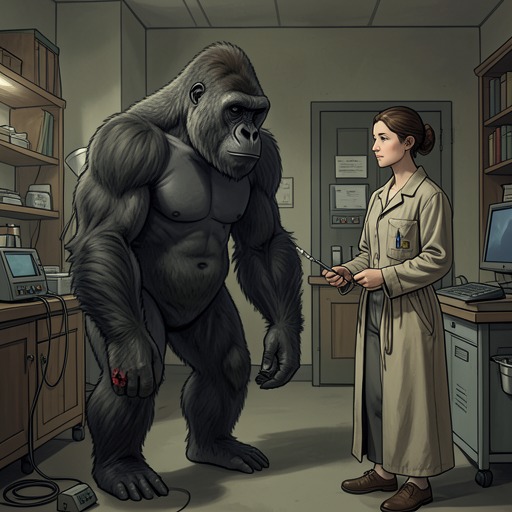
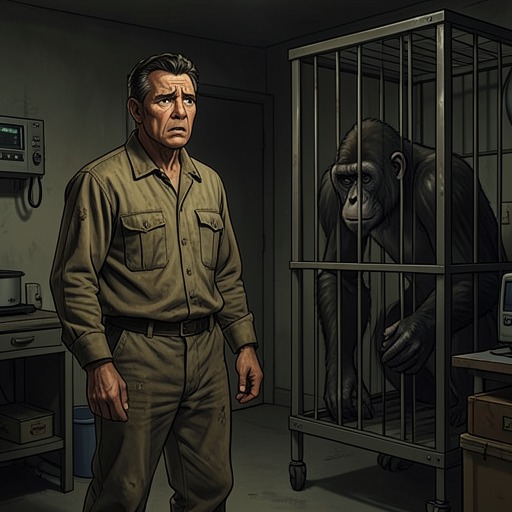
The novel places this coercive training within a wider change at the mall. A tall man arrives to inspect the property, making check marks after looking at the animals’ surroundings and supplies, including Ruby’s hay and the water bowls. A week later he returns with a woman in a white coat; she watches Ivan and Ruby, speaks with the inspector and Mack, and Mack receives a sheet of paper. The text does not specify the rules or conclusions behind the inspection, but it marks a shift from the animals being watched as a show to their conditions being examined. Later, the woman returns with other people and a box sized for Ruby. Ivan understands that she has come to take Ruby away.
The woman introduces Ruby to the box through a different pattern of instruction. She puts an apple inside, speaks kindly, and lets Ruby inspect it with her trunk. When Ruby touches the box, a click from a small piece of metal is followed by a piece of carrot. Repetition links exploration with a reward, rather than using a chain and threatened hook to force movement. The contrast does not erase Ruby’s earlier treatment, but it demonstrates another way to guide her behavior as she prepares to leave.
Significance
The training practices make the gap between performance and welfare concrete. A trick that looks controlled from the audience’s side depends on the animal being made to stand, balance, or move under pressure; Stella’s infected foot and Ruby’s bound feet show what that arrangement costs. Their stories also distinguish different forms of human control. The claw-stick, chains, and ropes restrict through fear and force, while Ruby’s box training uses food and patient repetition to elicit approach. When Ivan later watches a nature program showing gorillas eating, grooming, play-fighting, and sleeping, the animals’ ordinary behavior stands apart from the staged tricks at the mall. Together, these contrasts frame circus training as a system that turns animals into performers by narrowing what their bodies are allowed to do.